
The Architect Is Not the Smartest Person in the Room
15 years as an introverted architect taught me you can get ahead without becoming someone you are not.


Barack Obama said something in a podcast interview that has stayed with me. His message to young people, the ones who assume the top of any field is full of geniuses, was that you should never let anyone make you feel you do not belong. Once you have had some exposure to the rooms where decisions get made, you realise the people in them are mostly ordinary. What sets them apart is rarely brilliance. It is access, exposure, and the confidence that comes from being treated as though they belong. They are not a different species. They were let into the room.
I keep coming back to it because our profession tells architects the reverse. It says you have to prove you are the exception before you are allowed to belong.
Somewhere on the way to the title, many of us absorb a belief about what an architect is meant to be. The smartest person present. The one every hard technical problem routes to, because you are the architect, so surely you hold the deepest answer on every subject. The strongest voice, the one that wins the room by knowing more than anyone else in it. Hold that belief long enough, and it changes how you carry yourself.
I held it for years, and it cost me.
You have probably felt this yourself. You are good at the work, maybe better than some of the people getting promoted ahead of you. And in workplace after workplace, the same message keeps coming back: you are too introverted, you lack presence, you need to be more visible if you want to move up. So you are left wondering whether getting ahead means turning into someone you are not. The answer is no. I spent years getting that wrong before I got it right. So this is about how to grow and lead as the architect you already are, without giving up the parts of yourself that got you here.
The job was never to be the smartest in the room
Gregor Hohpe, who wrote The Software Architect Elevator, puts it about as plainly as anyone in our field. The architect, he argues, should not be the smartest person in the room handing out instructions. The job is to help make everyone else in the room a little smarter. He calls the architect an IQ amplifier for everyone else.
That one reframe takes the weight off you.
An architect who tries to be the cleverest person in the room ends up hoarding decisions and talking down to the specialists who know their own domains far better than he does. The engineers know the code. The security lead knows the threat model. The finance lead knows what the business can afford. Your job is to get those people talking to each other, to spot the trade-offs none of them can see on their own, and to help them reach a decision none of them could have made alone. You build the shared picture everyone can work from. On a good day, everyone walks out sharper than they walked in, and nobody can point to the exact thing you did to make it happen. That is how the best architecture work goes, in my experience. The wins are the kind you can barely see, a decision that turned out right, a risk that never became a problem, complexity that never built up. Those wins are rarely celebrated in the room.
I learned to be that kind of architect on a major transformation at a telecoms operator, building an API platform as the business shifted from primarily selling connectivity to running digital services. The developers were the subject matter experts on the systems in scope. They understood them far better than I did. My part was to let them own the system design, connect the dots across their work, and carry their ideas to the decision makers. I translated those ideas for the commercial and business leaders who held the budget, then secured the buy-in that turned good engineering into a funded programme. I was not the smartest person on that programme. I was the one who made sure the smartest people were heard by the people who paid for it.
That connecting work tends to matter more than the impressive solo acts architects are still rewarded for. And it suits a different kind of architect, the one who connects the work and leads the room, in their own reserved way. That instinct is a strength, even when it gets treated as a shortcoming.
The evidence that being loud is the wrong measure
If that belief has ever held you back, there is an interesting analysis you should check out, linked below. Its author, Nick Malik, suggested that courage is a core trait for architects in his work on personality traits for enterprise architects, and I couldn’t agree more. Courage is about being willing to take a position that is measurably better for your client, even if it means paying a personal price to propose it. A mark of an effective architect is to draw an unpopular but best-fit conclusion, make a difficult decision with integrity, and then have the courage to push it through as a standard for others to follow.
Nick Malik also shared conference slides on the personality traits of effective enterprise architects. In them, he used a personality framework to compare the architects he considered successful with those he did not. In his analysis, he observed that the architects he considered successful tended to sit near the middle of the personality scales rather than at the extremes. In his sample, raw extroversion did not, by itself, predict success, nor did being the most detached. What worked was being able to switch between listening and speaking up, depending on the situation, and I’d add that this takes courage.
Look at the wider leadership research, and you find something every introverted architect already knows. In a widely cited 2006 survey, 65% of senior executives said they saw introversion as a barrier to leadership. Only 6% thought introverts had the people skills to lead a team well. Yet when Adam Grant, Francesca Gino, and David Hofmann ran a field study on this, published in the Harvard Business Review in 2010, they found that introverted leaders produced better results than extroverted leaders when their teams were proactive. They listened, made people feel heard, and let good ideas run their course. The perception is that introverts lose. The evidence is more nuanced, and in the right conditions, the introverted ones come out ahead.
The route to becoming an architect is rarely a straight line
My first degree was in Biochemistry at a university in Nigeria, and I was bad at it. For that university system, a third‑class degree was the lowest passing honours band, and I barely made it. Nothing on that transcript pointed to the architecture career I would go on to build.
A few years before that, my mother bought me my first laptop when I was a teenager. That machine did more for my life than the degree ever did. I taught myself to build websites, HTML and CSS first, then the Zend Framework for PHP in the late 2000s and early 2010s, spending odd hours on Stack Overflow and breaking things until they worked. No one told me to. I did it because I enjoyed it, and I kept building on my own and gaining experience with system design. Before long, it started paying. I picked up clients on Elance, the freelancing site which later merged with oDesk to become Upwork.
The road from there ran through cloud computing. When the cloud boom created a new role, the cloud architect, I earned professional architect certifications from the major cloud service providers and kept climbing. But the technical depth was never what held me back.
The thing holding me back was the room.
In 2016, I was accepted to speak at a conference run by the Software Engineering Institute at Carnegie Mellon. I had taken one of their methods, a structured way of evaluating architectural trade-offs called ATAM, applied it at my work, and was going to stand on their stage and talk about it with the people who created the method sitting in the audience. I was frightened. Every reserved instinct told me to back down and stick to the technical work where I felt safe, rather than communicating it on stage.
I did it anyway. It did not go perfectly, and it did not need to. What I learned that day has held ever since. Confidence did not come first, and then hand me the courage to speak. It ran the other way. I spoke while scared, and the confidence arrived afterwards, built from the doing. You do not talk yourself into it in the mirror. You outwork the self-doubt one uncomfortable room at a time. If that is you, do not wait to feel ready. Pick the smallest room where you can speak up this week, and use it.
The trap of becoming acceptable
There is a second pressure, and it has little to do with how good you are at the work. I was already an architect when I became an immigrant, and I had to find my feet in a new country from scratch. You leave home for a place where the language is new, the unwritten rules are invisible, and in some rooms the assumption is that you must be a diversity hire rather than there on merit. You are asked, in dozens of small ways, to justify a presence that others are simply granted.
For an introvert, that pressure does something specific. It teaches you to make yourself smaller. You start managing yourself down into something easier to supervise. You soften the directness. You temper the ambition so it no longer makes less ambitious people uncomfortable. You take a great deal of advice about becoming warmer, more agreeable, more coachable, and easier to be around.
I tried versions of that for a while. It did not make me a better architect. It made me smaller, slower and easier to overlook.
That does not mean I am always right. I have made my share of mistakes, including chasing approval from people who never mattered to the work. Some of the feedback I got was fair, and I took it. I go looking for it because that is how you grow. But I had to learn to weigh it, because confidence is easy to mistake for competence.
What I hold on to now is the difference between 2 things that look alike on the outside. One is getting better at how you work, which is always worth doing. The other is changing yourself so much to fit in that there is less of you left. The test is simple. When feedback lands, ask which of the 2 it is. If it makes you sharper at work, take it. If it mostly makes it easier for someone else to handle you, hold onto yourself.
Holding onto yourself comes at a price, and it helps to name it. It means some people will not like you for it. Kishimi and Koga built a whole book around this idea, The Courage to Be Disliked, drawing on Alfred Adler’s psychology. Their argument is that trying to be liked by everyone is its own kind of trap, and that freedom begins when you accept that being disliked by some is the cost of living as yourself. This is the personal side of that same courage, the nerve to take the unpopular position even when it costs you. You cannot hold the right architectural line and keep everyone comfortable. At some point, you choose.
Self-leadership comes before leading others
The turn comes from understanding your own wiring before you try to manage anyone else’s. For me, that meant some unglamorous homework on myself.
I have spent time with the instruments people use to map themselves. On the 16Personalities test, I come out as the Architect type, the reserved, strategic, future-focused profile, and in my case, the turbulent version of it, the one most prone to feeling misunderstood, which made me laugh out loud when I first read it. On the Gallup strengths assessment, my top 5 are Futuristic, Learner, Intellection, Focus, and Achiever, a stack that leans toward strategic thinking and steady effort rather than charm and performance. On a third tool, PrinciplesYou, built on Ray Dalio’s work, I come out as a Shaper, someone who fixes on a goal and drives through obstacles, with attributes of the Quiet Leader and the Strategist alongside.
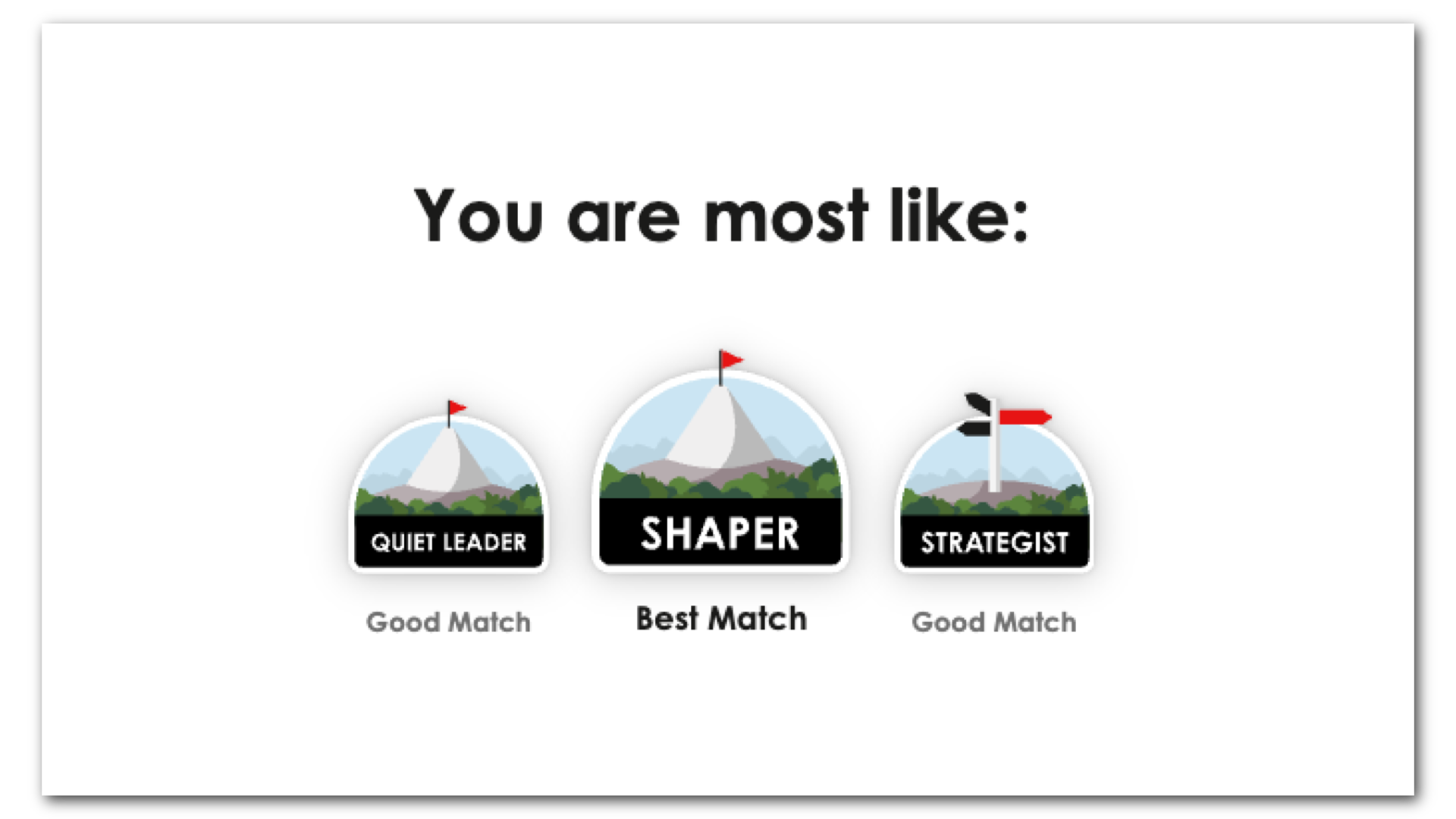
None of these tools is gospel, and I do not treat them as science. What they gave me was a mirror. All 3 said the same thing about me. My contribution was never going to be the warmest presence in the room or the fastest to charm it. It was going to be depth, foresight, structured thinking, and the grit to hold a hard problem until it gives way.
They named my growth areas honestly, too, and I needed to hear those. Sensitivity to how other people feel. Telling people when they have done good work. More patience. Self-leadership meant owning both halves, the strengths to lean into and the edges I genuinely had to work on, rather than swallowing a blanket instruction to become a different person.
There was one line in those results I stopped apologising for. It described a kind of leadership that is as much about listening as speaking, reading the room and holding a position without raising your voice. I had spent years treating that as a flaw to correct. It turned out to be closer to what the job actually needs. If your instinct is to listen before you speak, you do not need to borrow an extrovert’s playbook to lead well. You need to run your own, on purpose.
It comes down to learning to say no. No to the roles that need a different kind of person and would leave you miserable and mediocre. No to the meeting that wants a stage performer when the work needs a thinker. You stop trying to force yourself into the shape of the louder, more charming presence that gets mistaken for strength, and you start building on what you actually do well. You lead other people better once you stop mismanaging yourself. Start by engaging in introspection, using an assessment tool, and better understanding your strengths. PrinciplesYou is a free one you can start with.
The reason this is bigger than your next review
Some time ago, I took my first degree off my LinkedIn profile. The third-class result in Biochemistry embarrassed me, and I had left it out. A former manager noticed and called me about it. He asked why I had taken it down. Then he told me something I had not considered. That degree, and the unlikely road from it to where I am today, was not the weak part of my story. For a young person from a background like mine, someone looking at this profession and wondering if there was any room for them, my strange route was the most useful part of the whole profile. Hiding it did not help that aspiring architect, so I put it back.
That call changed how I think about the whole thing.
I am a Black man, a Nigerian, an immigrant who rebuilt a career in a new country. When people from where I am from, or people who carry some part of my story, see the path laid out honestly, third-class degree and all, something shifts in what they believe is open to them. A bigger life starts to look possible for them. Being among the first in your own world to do a thing is not only a private milestone. It stretches the map for everyone who comes after you.
That is why I serve on The Open Group’s peer-review board that certifies architects. It is why I mentor the ones coming up. It is why I write and speak, even when it still frightens me. Not because I am the smartest person in any of those rooms. I am not, and the job was never to be.
The architect a room actually needs is the one who makes everyone else in it better. You do not have to become the strongest voice there to do that work, and you do not have to file away the parts of yourself that carried you this far. What you have to do is understand your own wiring, protect it, and point it at problems worth solving.
I write The Foresight-Driven Enterprise, a newsletter on enterprise architecture, foresight, and growing as a practitioner. If you want more like this, subscribe.
Further reading
Gregor Hohpe, The Software Architect Elevator (O’Reilly), and his talk “Thinking Like an Architect,” InfoQ presentation
Nick Malik, “Personality Traits of Effective Enterprise Architects,” the practitioner analysis. Slides and his companion article
Adam Grant, Francesca Gino and David Hofmann, “The Hidden Advantages of Quiet Bosses,” Harvard Business Review, 2010, on reserved leaders and proactive teams. PDF
The 65% and 6% figures come from a 2006 USA Today survey of senior executives, cited across the introverted-leadership literature.
Barack Obama on belonging and exposure, The Pivot Podcast, 2024. YouTube
Thank you! I needed that. 25 years into my career, trying to move on from purely technical positions and I struggled to find my footing. You point of view might help me to find a way I am more comofortable with.